My Favourite Places: Brooks Falls
If you love bears, you’ll love Brooks Falls…!
Bear Gills (taken at Brooks Falls)
I first heard about Brooks Falls just after I left university. I was visiting my best friend in London, but his mother told me he wasn’t home, so I had to make polite conversation while I waited. I asked her if she’d been anywhere nice on holiday, and she said, “Well, I’ve actually just come back from watching bears catch salmon in Alaska…”
That’ll teach me!
Getting There
I like long-haul wildlife. There you go. There’s no getting around it. I’m just not interested in anything I can find on my doorstep, so I have to take long-haul flights to find the big predators, such as tigers, lions and bears.
Bears are a good example. The only time I went to Alaska was in July 2015, and it took me 37 hours to get there! I had to fly from London to Seattle and then catch not one but two connecting flights, first to Anchorage and then to King Salmon. Brooks Lodge was full, so I had to stay at a nearby hotel and take a floatplane every morning!
These days, that can work to my advantage. If I’m giving a talk on wildlife photography, I’ll sometimes play a video of a plane landing on the Brooks River (see above) and ask the audience for a show of hands: “How many people have to take a floatplane to work in the morning?” When nobody puts his hand up, I say, “Ah, is it just me…?!”
Anyway, my regular commute to Brooks Falls was in a de Havilland Canada DHC-2 Beaver, which is apparently ‘a legendary single-engine, high-wing, propeller-driven bush plane’. It was also very small, and the safety briefing consisted only of the pilot telling me there was a life jacket under my seat!
Once I reached Brooks Lodge, though, it was only a short walk to the waterfall…
The Lodge
King Salmon Lodge
I spent five days in Katmai National Park, staying one night at Brooks Lodge and the rest at King Salmon Lodge, which was a rustic place built mostly out of stone and wood (see above).
As you might expect, the lodge was named after the local delicacy. King salmon (also known as Chinook) is the largest Pacific salmon species and famed for its exceptionally high healthy fat content, rich buttery texture and deep orange flesh. Prized globally as the ‘wagyu of the sea’, premium whole fillets (like sustainably raised Ōra King Salmon) are available via speciality retailers for around £130–£200.
Needless to say, salmon also played a big part in the restaurant’s menu. I was happy to eat locally caught fish, but just about every starter and main course included salmon, so by the time I flew home, I was ready for a plain old cheeseburger!
I had dinner with the other guests every night, and I met some very nice people. I remember having a really good chat with one particular couple, and I enjoyed talking to an older guy who was also on his own. The staff were very friendly, too, and nothing was too much trouble.
Daily Routine
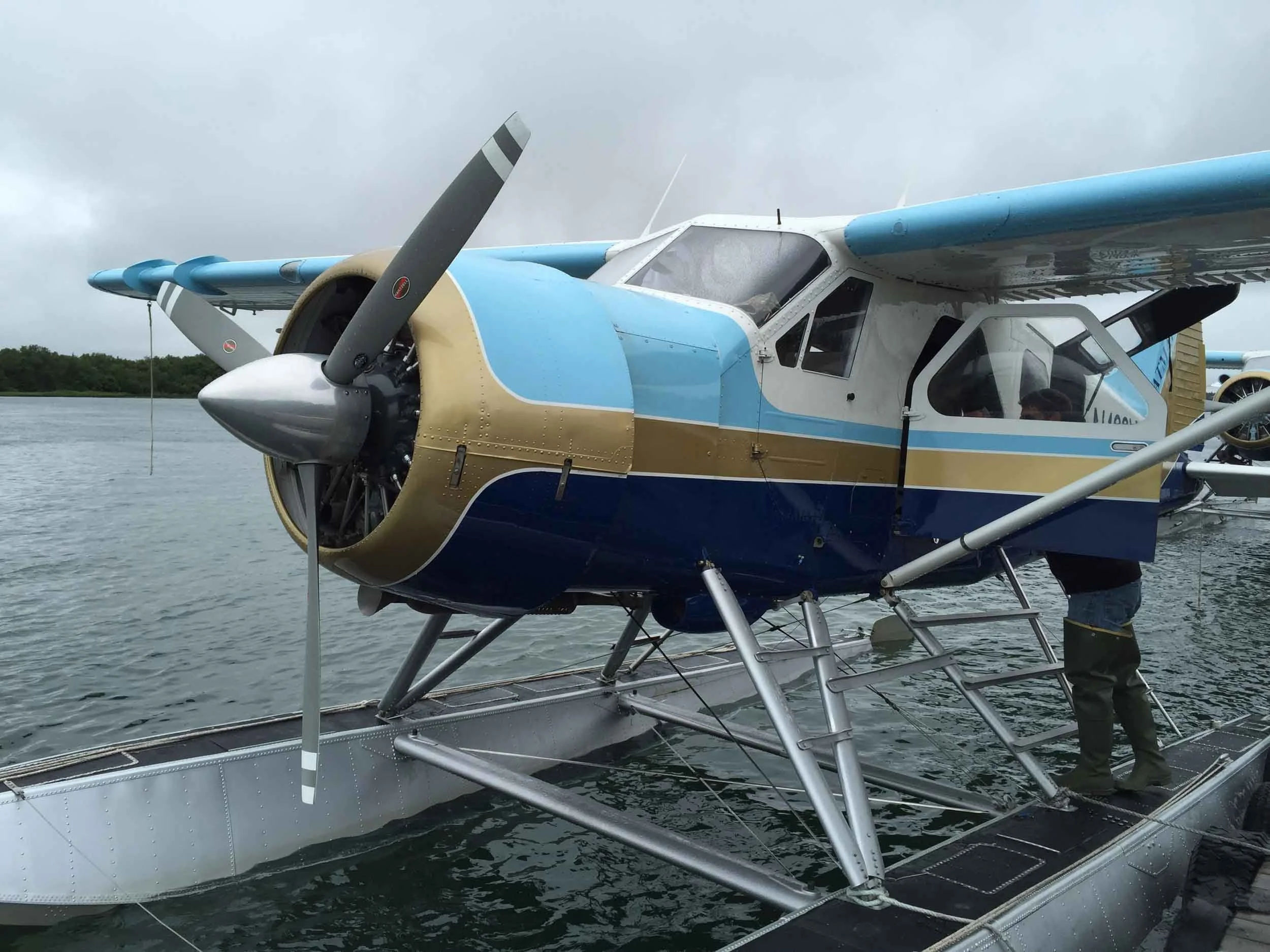
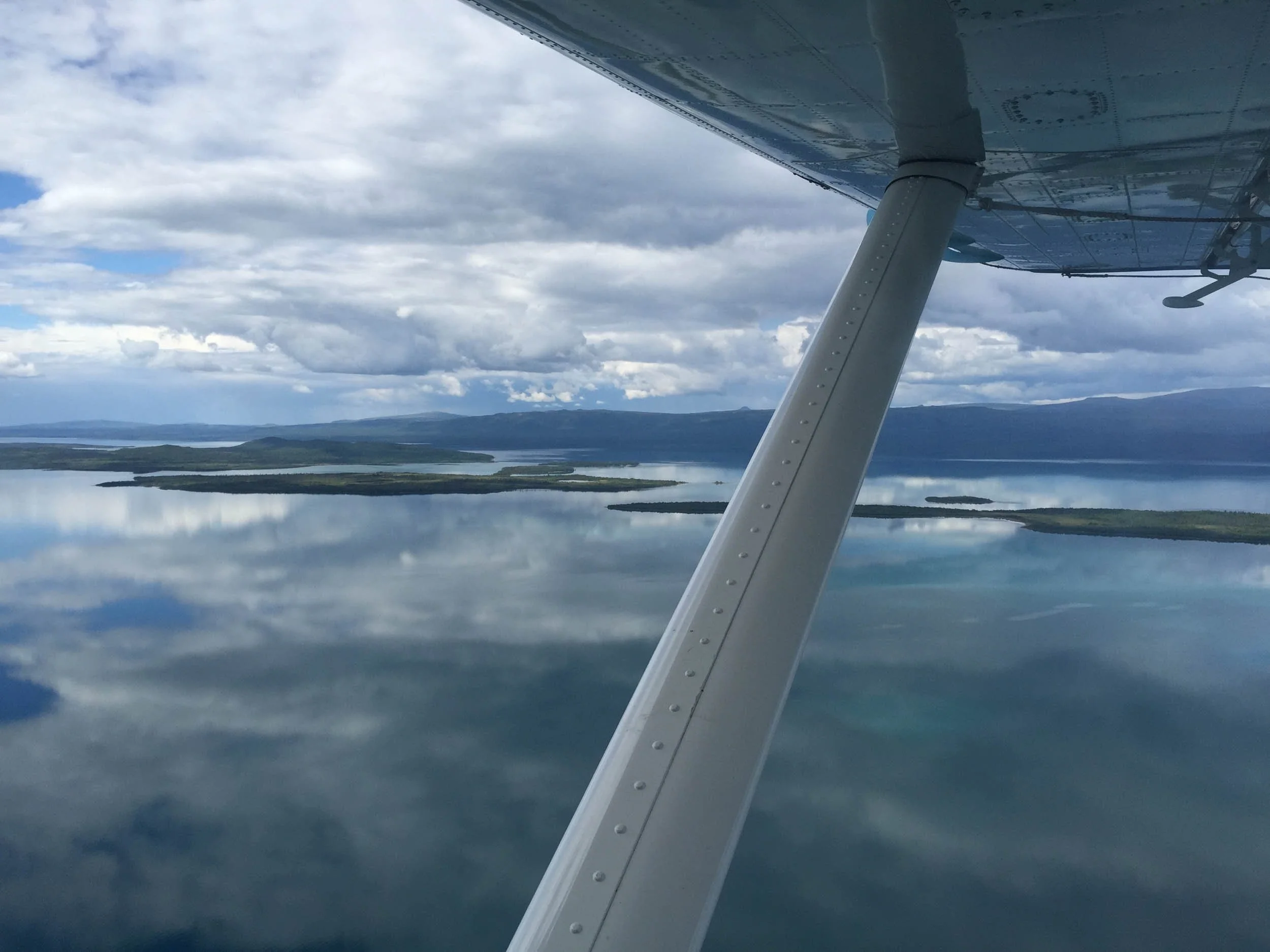
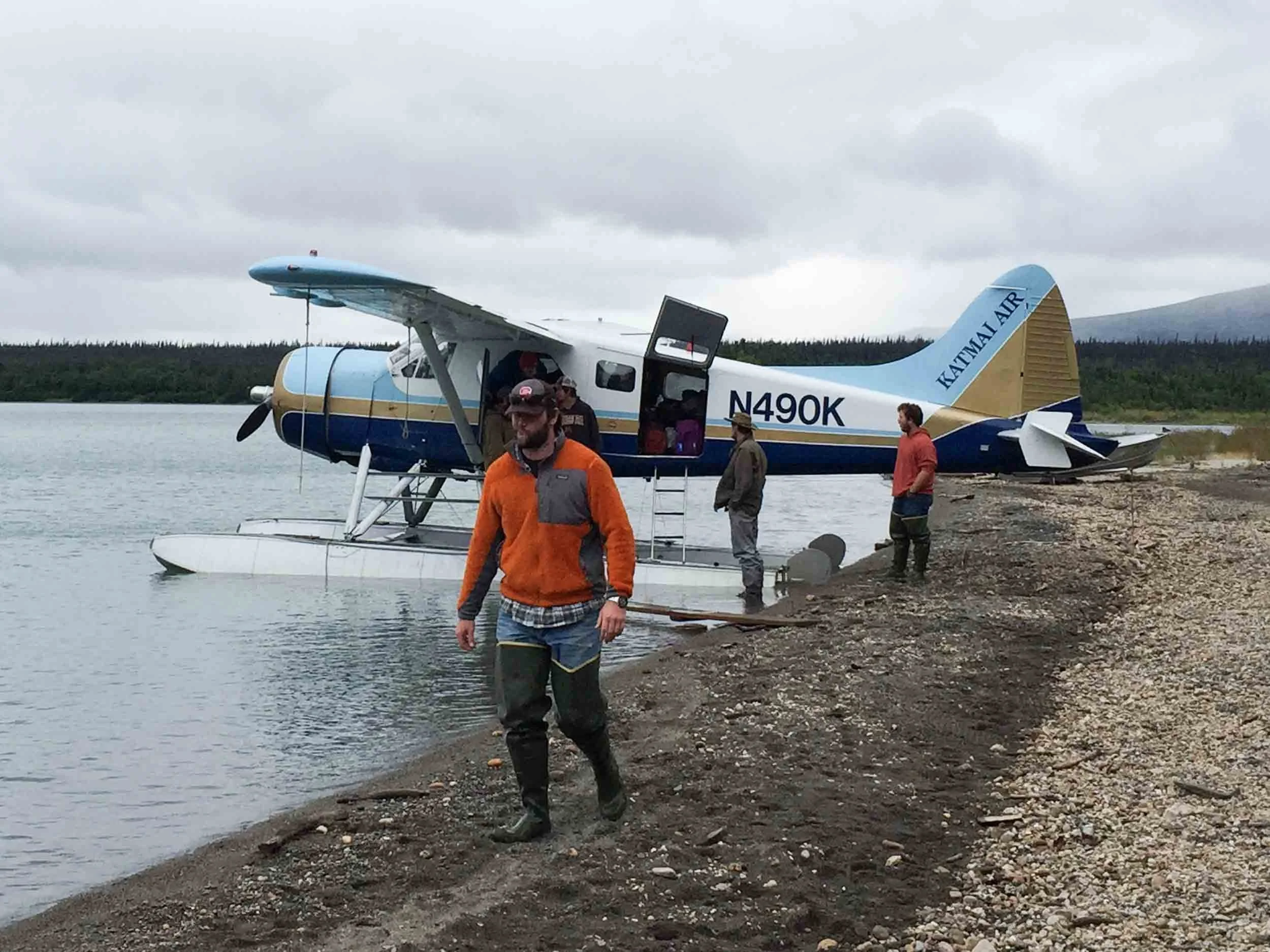
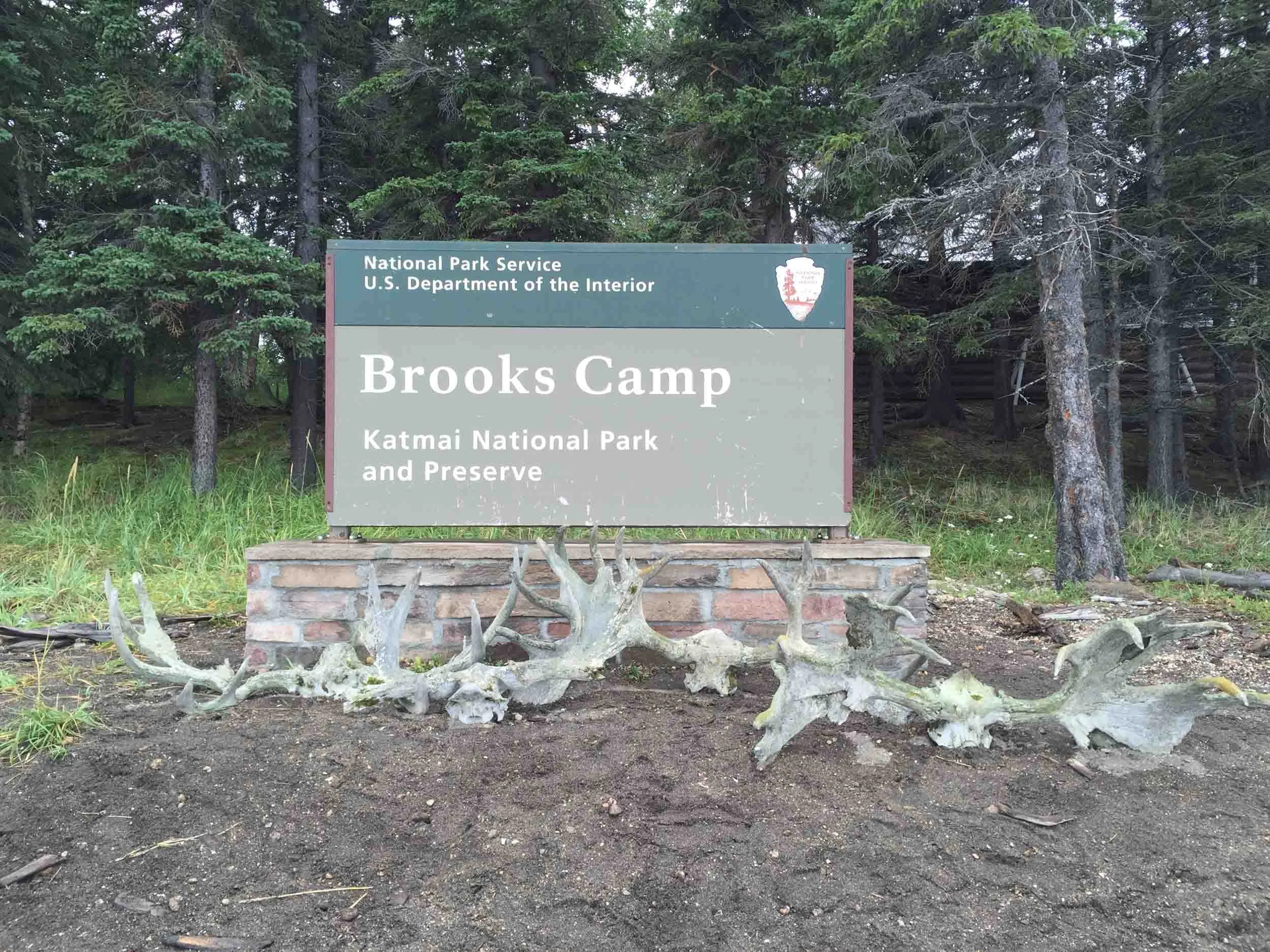
My usual daily itinerary largely revolved around planes and brown bears!
0710 Pick-up from lobby
0800-0830 Flight to Brooks Falls
0830-0900 Walk to the waterfall
0900-1300 Wildlife photography
1300-1400 Lunch
1400-1630 Wildlife photography
1630-1700 Walk to the beach
1700-1730 Flight back to King Salmon
1900-2000 Dinner
2200 Bed.
Staying in King Salmon did mean a fairly early start most mornings, but I’m normally an early riser, so I was used to that. The first time I arrived at Brooks Lodge, I had to attend what they called ‘Bear School’, which was an hour-long lecture on fieldcraft and safety in the woods. Brooks Falls was an unfenced camp, so everybody needed to know how to behave in the presence of bears.
Confusingly, almost everything we were told was very counter-intuitive:
If you’re walking to the falls, don’t try to be as quiet as possible.
If you see a bear, don’t run away.
If you’re attacked by a bear, don’t fight back.
Anyway, once we’d been indoctrinated, we were all given our very own ‘bear pin’ (or button) to prove our credentials, and we had to wear it all the time from then on.
The whole point of going to Brooks Falls was to see the local brown bears catching salmon. Every year in late July, a million salmon swim from the Pacific Ocean to their spawning grounds on the Brooks River, and Brooks Falls are the very first obstacle they come across.
The falls themselves aren’t very high - only about six feet (1.8 metres) at their highest point - but try telling that to a salmon! You can find all five species of Pacific salmon there, but the most common are the sockeye (or red) salmon.
When I was there, I saw salmon jumping the falls every day. There were often up to a dozen in the air at the same time! The local bears obviously knew all about them, and up to 10 or so would gather in the morning and try their hand at fishing!
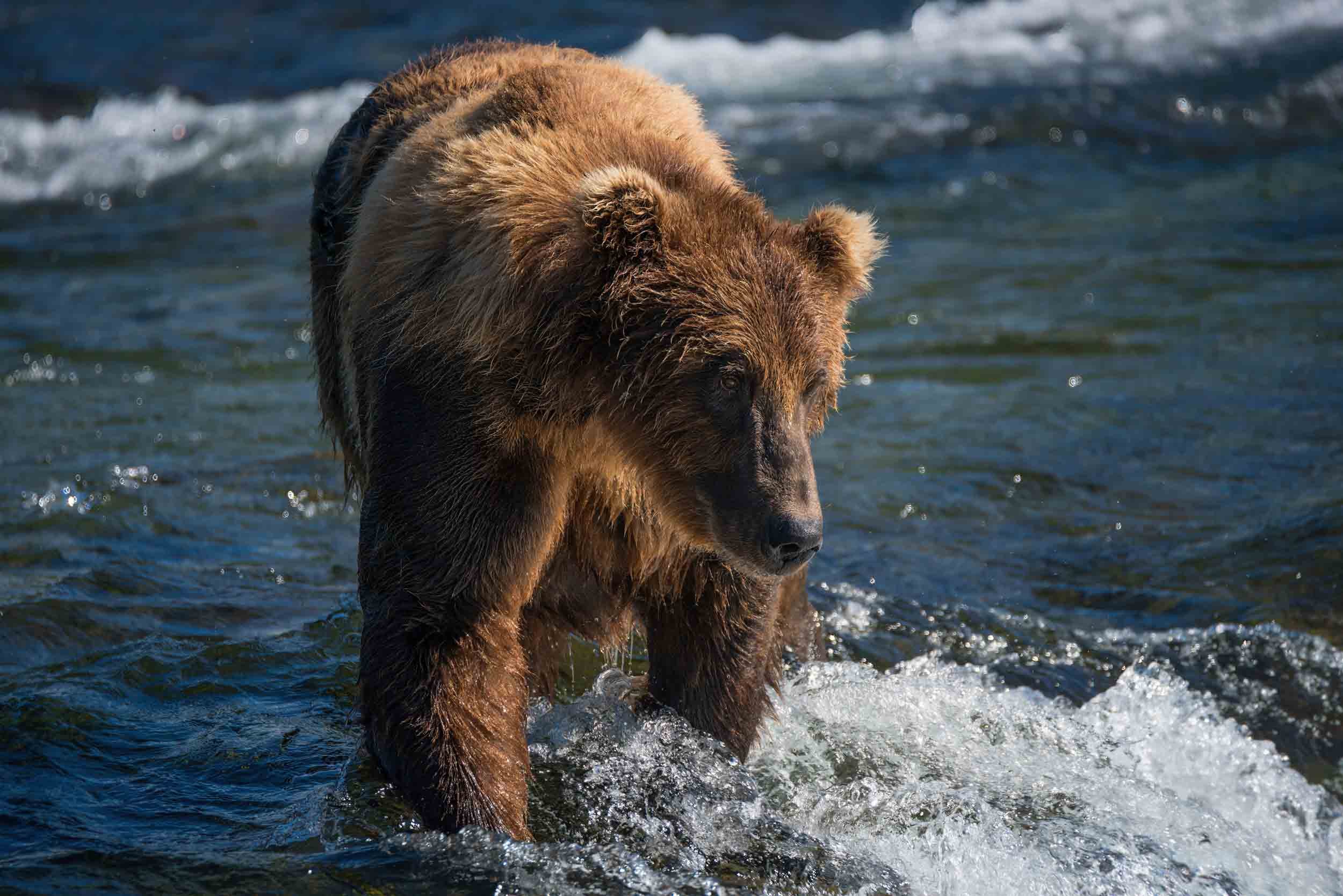
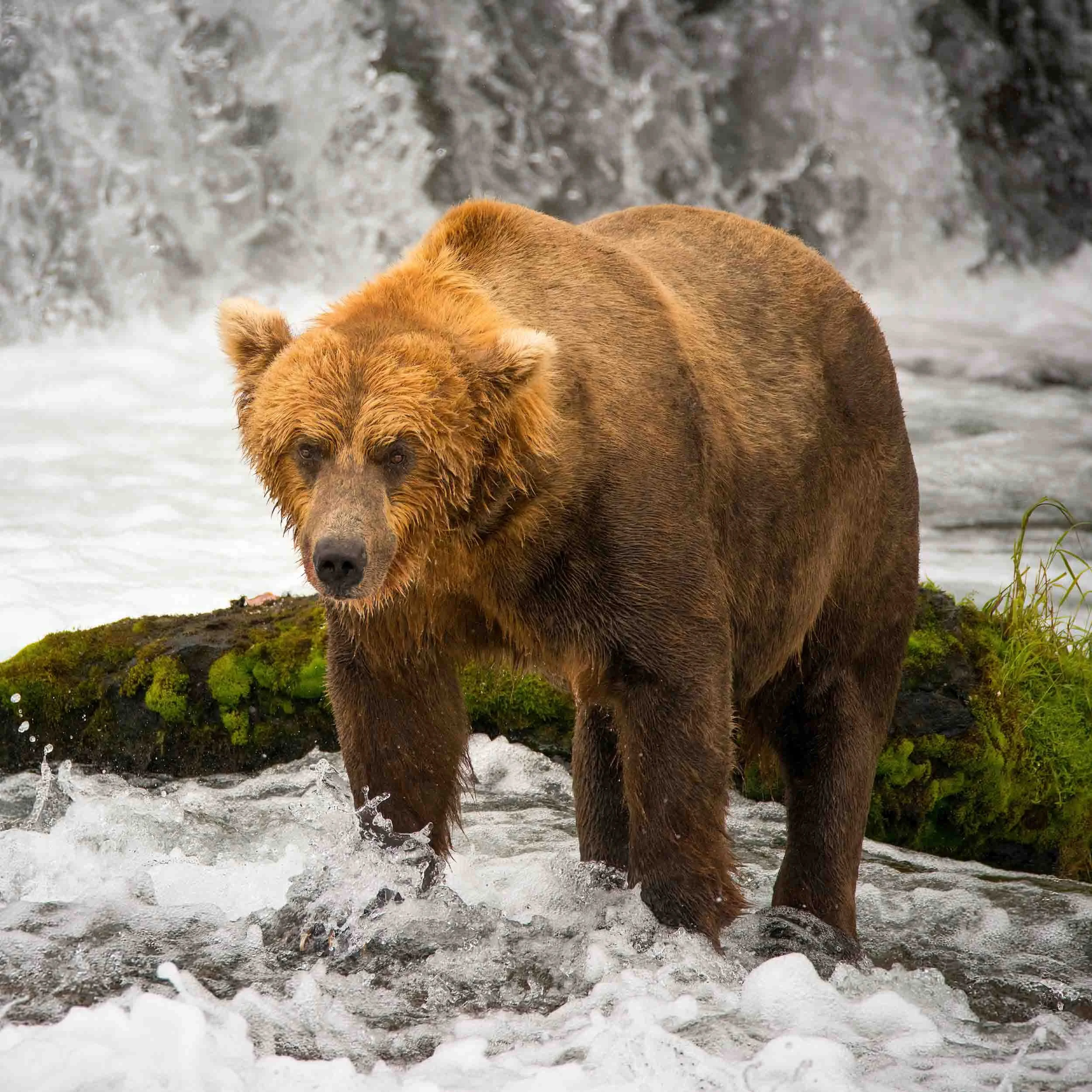
Brown bears (Ursus arctos) are the same species as grizzly bears, but people just call them brown bears along the Alaskan coastline. According to a sign I saw while I was there, they can eat up to 90 lbs (41 kg) of salmon in a single day! They’re also quite fussy eaters. They like salmon caviar, so I sometimes saw one rip open the belly of a fish and check for any eggs. If it was a male, it would throw it away and try again! They also like the fatty deposits just under the skin, so they’d often strip the skin off the fish and eat that before discarding the rest…
Different bears adopted different strategies. One or two would stand on the waterfall, hoping to catch fish in mid-air, but others would paddle around below the falls and ‘snorkelling’ with their heads underwater, looking for fish that fell back after trying to leap the falls. I also saw a female bear with three or four cubs who was so worried about protecting them that she stayed on the riverbank. Every time she saw a salmon, she’d bellyflop into the water and try to catch it. She wasn’t very successful at it!
Finally, there was the alpha male. He didn’t actually need to catch fish himself. Every time he wanted one, he simply walked up to another bear that had caught one and just stood there expectantly. After a few seconds, the other bear would accept the inevitable and drop the catch at his feet! Nice work if you can get it…
Anyway, there were various places to watch and photograph the bears, but the main waterfall was the obvious destination. Unfortunately, that meant battling through the crowds as everyone else had the same idea! I was only there for a few days, but there were always so many people that the park rangers would only allow photographers with their tripods to stay on the bleachers for an hour. After that, I had to go to the back of the line and queue up again! On one occasion, they forgot about me completely, so I never managed to get back into position, and on another day, I was kept waiting for four hours…
In addition, the weather was miserable. It was notionally the Alaskan ‘summer’, but it was cloudy, rainy and cold almost every day, and we only had a few hours of sunshine. That meant it was quite hard work waiting around for the bears and the salmon. It was also very frustrating when there were salmon but no bears or bears but no salmon!
Wildlife
Bears
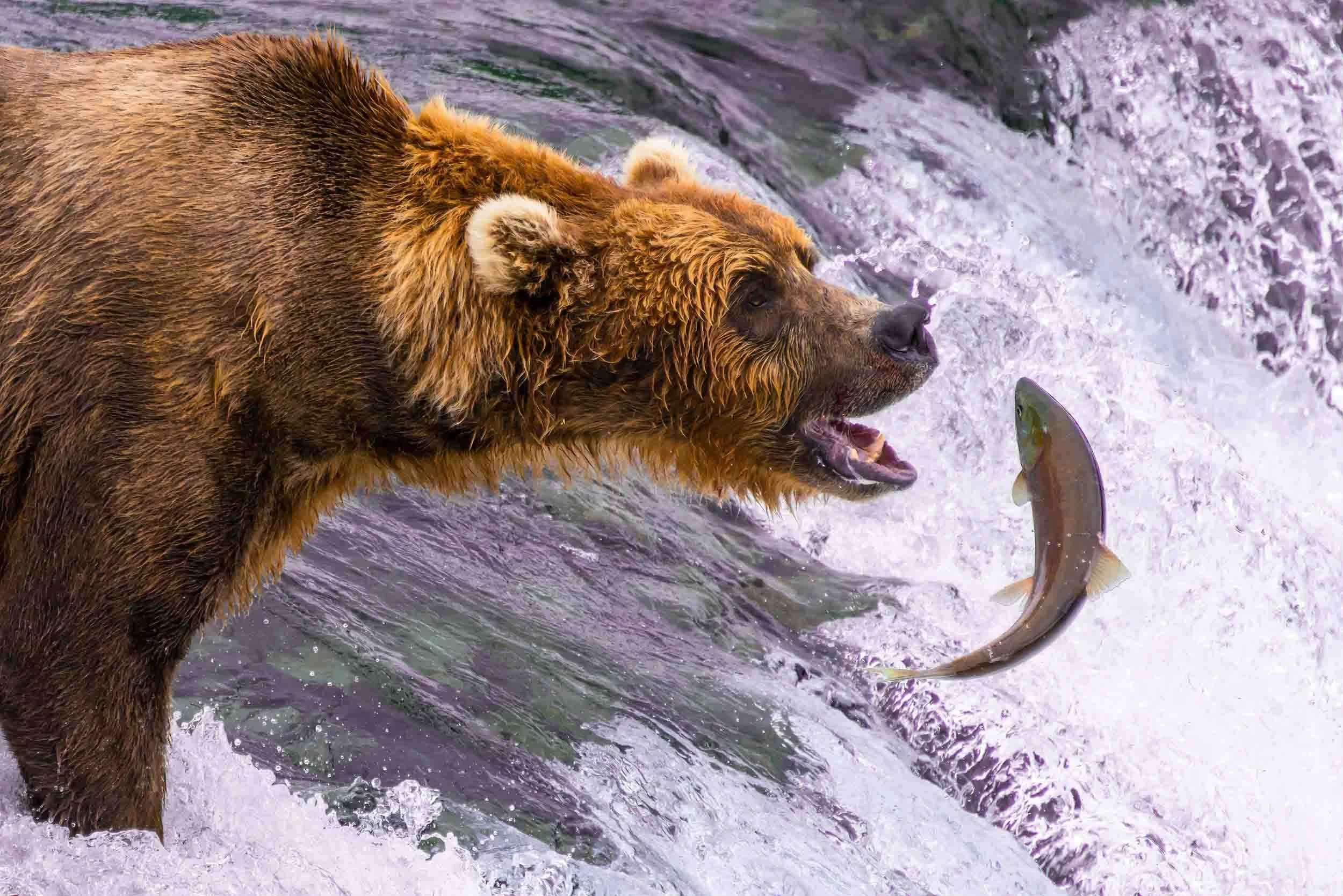
Brooks Falls is all about bears catching salmon. You’ll see the odd seagull or maybe a bald eagle, but that’s about it…! The main reason it’s so popular these days is Catch of the Day, which is a famous photo taken by Thomas D Mangelsen. He was one of the first wildlife photographers to ‘discover’ the potential of Alaskan bears, and it’s an iconic capture that sums up the appeal of the place.
In a way, I wanted to repeat the trick. I wanted to take a picture of a bear on the waterfall with its mouth open, just about to catch a salmon in mid-air. However, the opportunities were very limited. The salmon run only lasts a week or two, and it’s never the same each year, so there’s no guarantee you’ll be there at the right time.
In addition, the bears would only open their jaws at the very last minute, so the window of opportunity was only a fraction of a second. The difficulty was compounded by the fact that you never knew when a salmon would jump out of the water. I started out looking at the bear through the viewfinder, but I quickly learned that I had to watch the surface of the water. Otherwise, my reactions just weren’t good enough to press the shutter in time.
Everything was made worse by the limitations of my camera gear. Nowadays, I’m used to shooting with a mirrorless Nikon Z8 with Pre-Release Capture, but when I visited Alaska, I had a Nikon D800. It was the best Nikon had to offer at the time, but its frame rate was only 4 fps—or 6 fps with the battery pack! That meant I’d be lucky to get more than one or two shots of the fish while it was in mid-air…
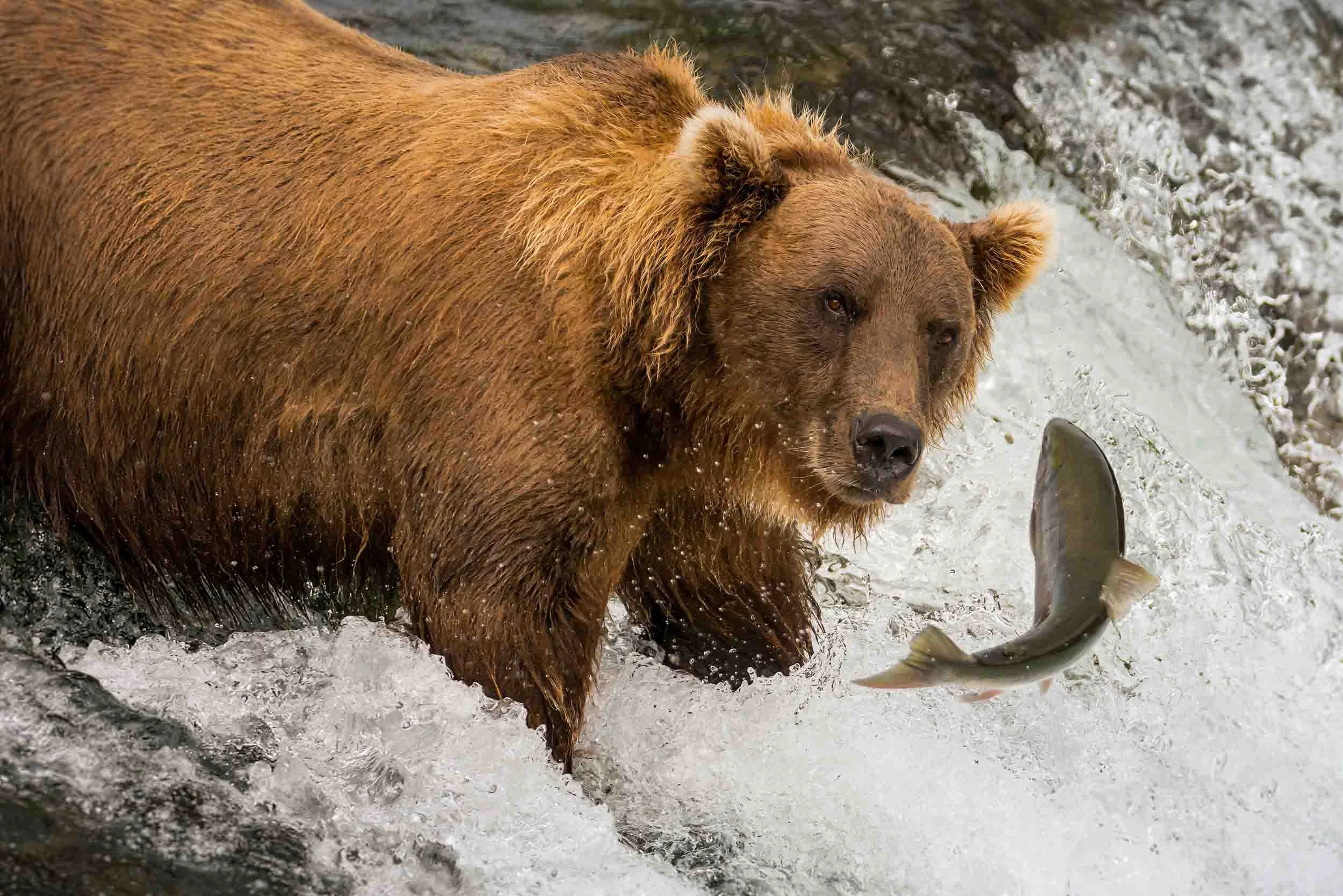
It’s true that I did eventually manage to take what’s probably my best ever wildlife photo, Bear Gills (see top of article). However, it was a long time coming. People sometimes ask me how long it took to take the shot, and I tell them, “It was either 1/1600 of a second or a week, depending on how you look at it!”
I often meet people who want to see my photos, and I always show them my favourites, including Bear Gills. On one trip to Kenya, I showed it to another guest and explained that it was a kind of ‘hommage’ to Catch of the Day. The guy was in a bit of a hurry to get back to his room, though, so we didn’t have much time. I couldn’t remember his name, so I asked him, but he just said, “I’ll tell you at dinner.” That was a bit weird, but I soon forgot about it.
Later on, as everybody was chatting over dinner, the same guy leaned over to me and whispered, “My name is Thomas D Mangelsen.” I couldn’t believe it! I was also very embarrassed for not recognising him, so I apologised profusely. Fortunately, he took it in his stride and said my shot was ‘a very nice picture’, accepting it as a compliment. Phew!
Ironically, Tom actually ended up paying for a link in one of my blog posts to advertise Catch of the Day! What goes around comes around…
The only other shot I took of a bear with its mouth open and a salmon in mid-air was Bear Necessities (see top of section). The reason I mention it is that it was one of the first of my images I ever saw in print. My friend Andy told me one day that he’d seen a picture of a bear in The Evening Standard and asked if it was one of mine. I assumed it wouldn’t be, but when he showed me his copy of the paper, I realised it was my very own Bear Necessities! What are the chances…?
Cubs
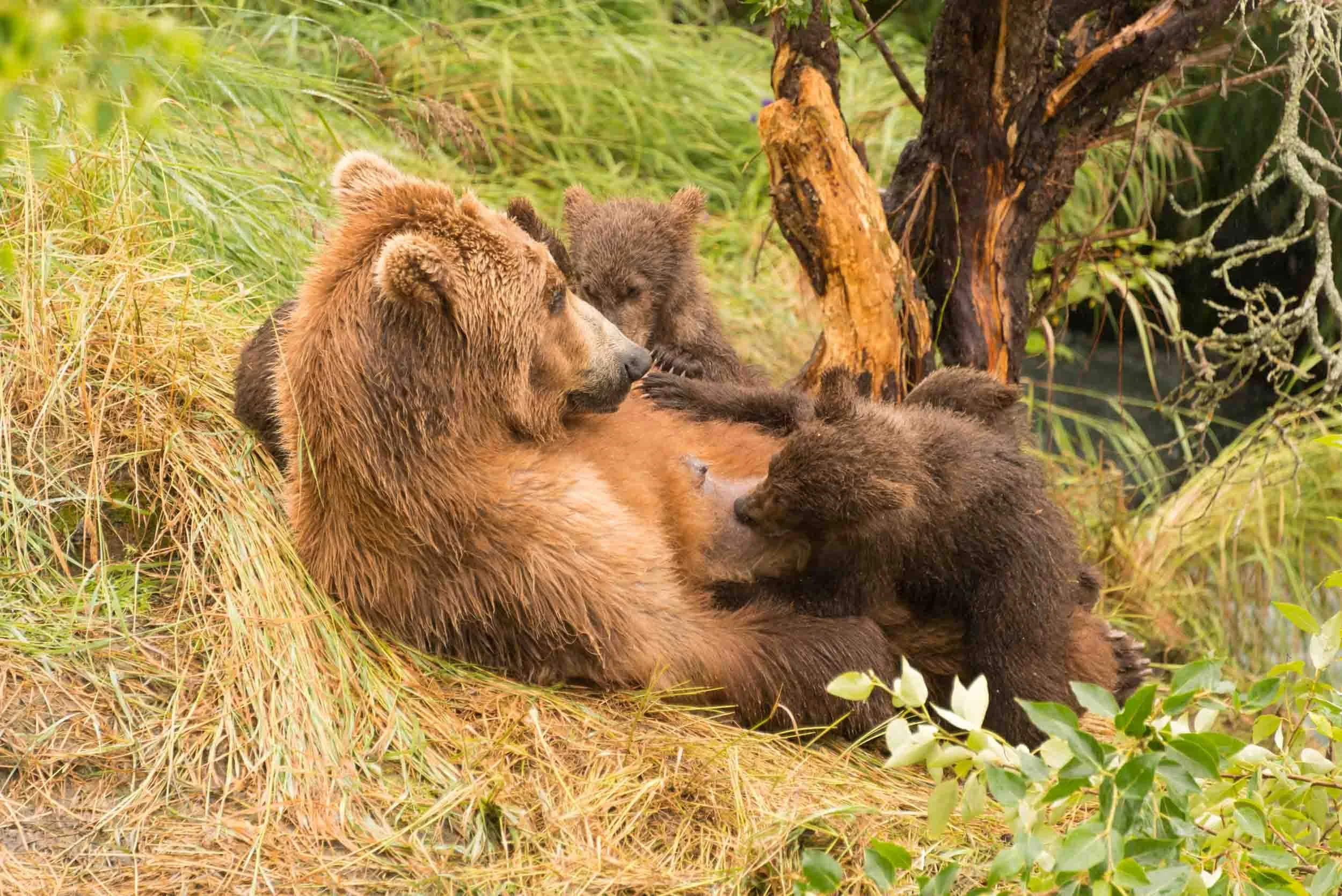
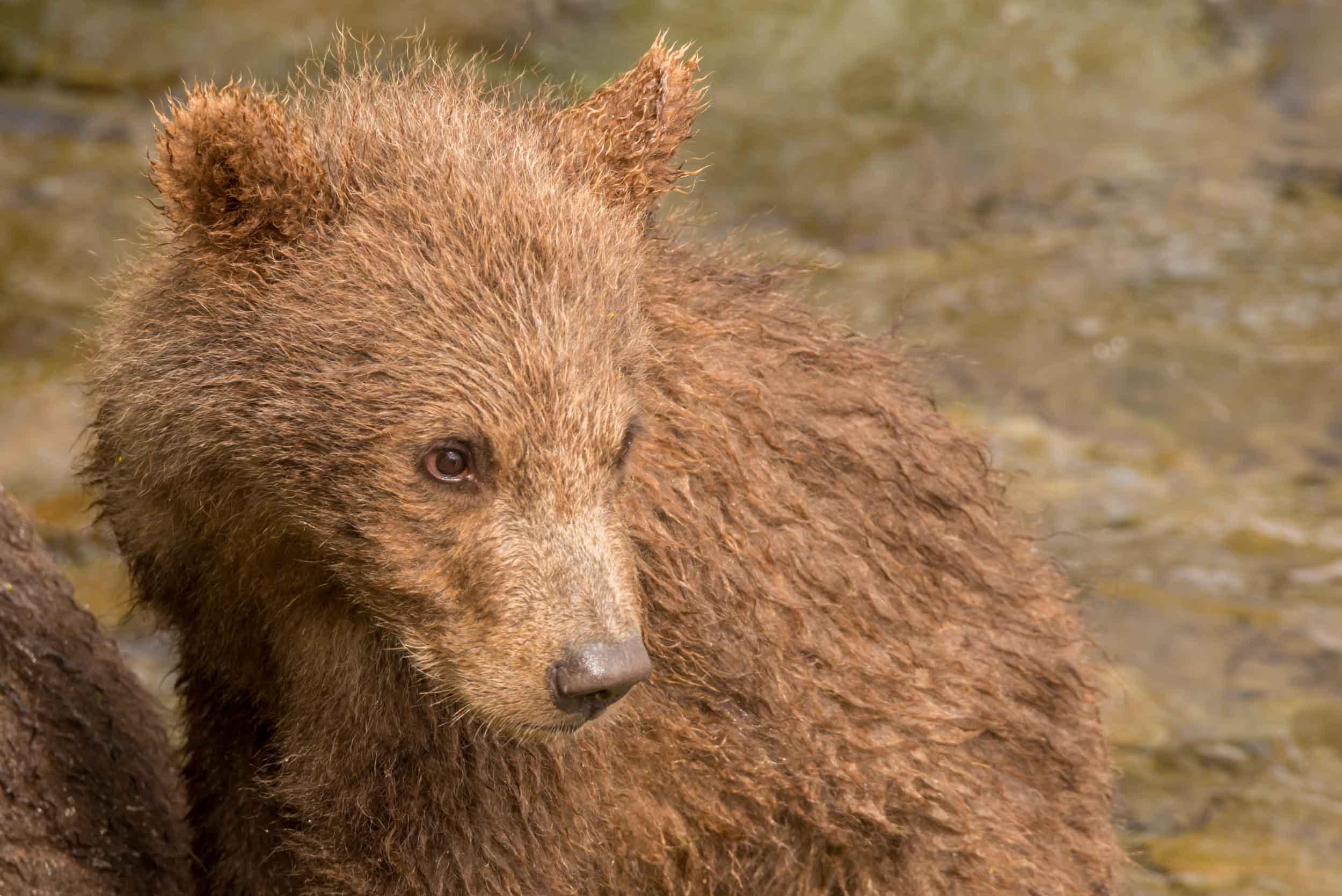
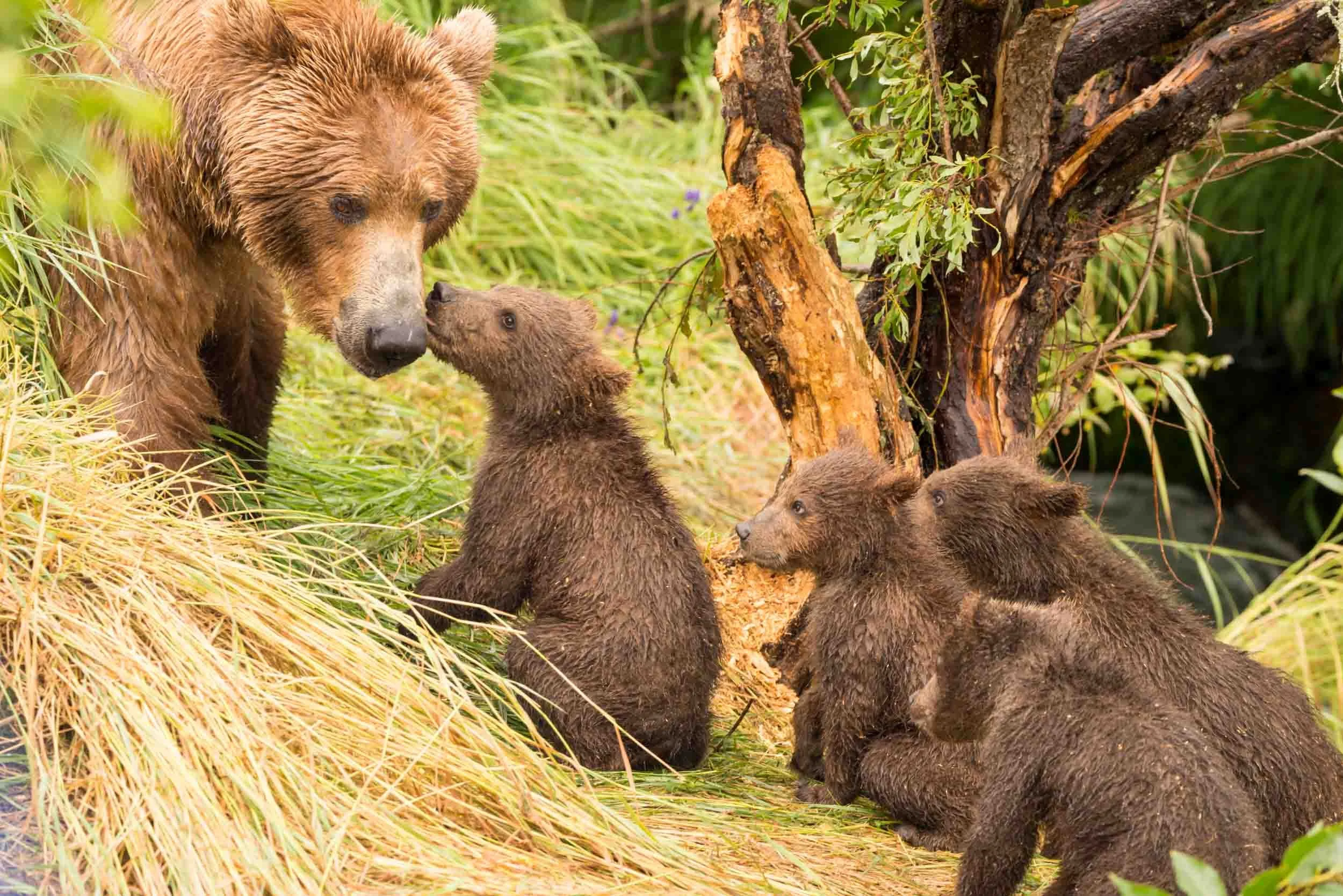
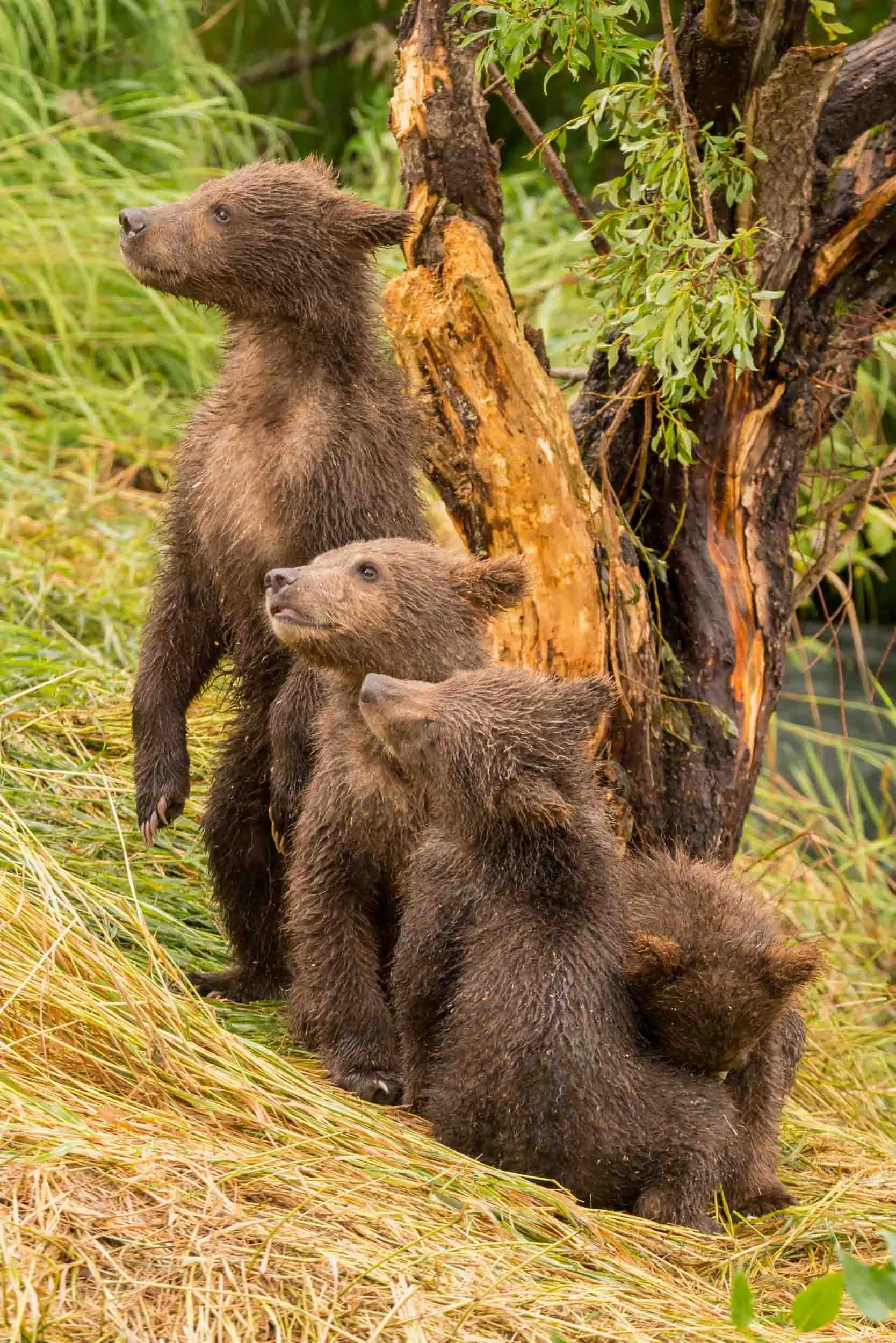
The other reason to get excited at Brooks Falls was the bear cubs—but they were as much a distraction as an opportunity! Many’s the time I should’ve been concentrating on the bears catching salmon but was distracted by the cubs climbing a tree or suckling from their mother…
Verdict
Brooks Falls is probably the best wildlife photography destination outside Africa. Yes, it’s very touristy, and it’s become so popular that you literally have to win the lottery to book a room at Brooks Lodge. However, if you’re lucky enough to spend any time there, you’ll appreciate the amazing scenes of brown bears catching salmon.
It’s a photographic challenge and a real test of your patience and ability to withstand miserable weather, but if you have a mirrorless camera with Pre-Release Capture and a 30 fps frame rate, it definitely belongs on your bucket list!
If you’d like to order a framed print of one of my wildlife photographs, please visit the Prints page.
If you’d like to book a lesson or order an online photography course, please visit my Lessons and Courses pages.